Human Bot Fly Myiasis
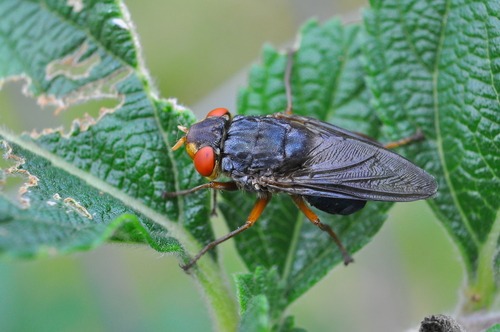
Image by Frederico Acaz Sonntag is licensed under CC BY-NC
|

Image by Geoff Gallice from Gainesville, FL, USA, CC BY 2.0
|
What is human bot fly myiasis?
Myiasis is the condition caused when human or animal tissue is invaded by fly larvae (maggots). The human bot fly (Dermatobia hominis) is the fly species that most often infests humans with its larvae, although it also parasitizes a wide range of wild and domestic animals, including cattle, sheep, goats, pigs, dogs, cats, rabbits, monkeys, buffalo, and even some birds. D. hominis sometimes goes by other names, including the torsalo and American warble fly. The adult
D. hominis measures approximately ½-inch in length, approximately the size of a bumblebee. It has a blue-gray thorax, a metallic blue abdomen, and yellow orange legs. The adult has no functional mouthparts and takes no nourishment. Food stored during the larval stage provides the adults with nourishment.
Where is
D. hominis found?
D. hominis is only found in the Americas. It is distributed from southern Mexico down throughout Central America and parts of South America to northern Chile and Argentina. In the United States, human bot fly myiasis is most often seen in travelers returning from rural parts of endemic countries.
How does
D. hominis cause bot fly mayiasis?
The female bot fly captures a blood-feeding fly (commonly a mosquito) in midair, where she proceeds to glue 10-50 eggs to the underside of the captive insect’s abdomen. When the mosquito subsequently feeds on a warm-blooded animal (host), body heat from that host causes the eggs to hatch, generally within 5 minutes, into a tiny larva known as the first instar. The larva enters the host’s skin through the bite wound, other abrasion, or hair follicle. The larva may occasionally penetrate directly through intact skin.
Is bot fly myiasis serious?
Although myiasis due to the D. hominis is rarely fatal or even seriously detrimental to the health of an animal or human, the larva, which remains in the skin for up to 10 weeks, produces a painful nodule, boil, or “warble." In rare instances they can occur in body cavities such as the eyes, ears, or nose. D. hominis is an especially serious pest of cattle in parts of Brazil and Central America, where heavily infested young animals may die and where the loss of meat and milk production, as well as damage to hides, can result in significant economic losses.
What happens once the larval D. hominis enters the skin?
Using its mouth hooks and the rings of tiny spines encircling its body segments, the larva burrows down into the subcutaneous layer of skin, positioning itself “head down.” The openings to the breathing system (called “spiracles”) are on the posterior end, which it positions at an opening in the skin so that it can breathe. The larva remains in one spot, feeding on the host’s tissue and developing (molting) from its tiny first larval instar stage through two successively larger instar stages. After spending a total of 6-10 weeks feeding and growing within the skin, the third instar larva, which measures approximately 1-inch in length, drops from its host, burrows into the ground, pupates, and after 4-11 weeks, emerges as an adult bot fly. The adult only lives a few days and does not feed. The bot fly life cycle is complete when it mates and lays eggs on another blood-feeding fly followed by its death.
How can I tell if I have been infested with
D. hominis?
The initial symptom of the presence of a bot fly infestation is a small nodule in the skin that continues to enlarge over the course of several weeks. Unlike the puncture wound caused by a mosquito, the infected nodule discharges blood or serum continually because the larva needs to keep the wound open in order to breath. The wound often itches, and sometimes intense shooting pain occurs when the larva shifts position or matures to another instar. As the larva grows, movement can often be seen below the surface of the wound, and the posterior tip of the larva may be visible at the wound opening.
Is there treatment for a bot fly infestation?
The larvae need to be surgically removed by a medical professional. Typically, the wound is cleaned daily after the larvae are removed. Proper hygiene of wounds is very important when treating myiasis.
Can human bot fly myiasis be prevented?
During deployments or travel to Mexico, Central-, and South America, use the DoD Insect Repellent System to protect yourself from mosquitoes and other biting flies that may carry D. hominis eggs. The system incorporates permethrin repellent on the uniform, DEET or picaridin repellent on exposed skin, a properly worn uniform, and sleeping under a permethrin-treated bed net. In addition:
- Take extra care going to tropical areas and spending a lot of time outside. Cover your skin with clothing; it provides a physical barrier for mosquitoes and other flies. Wear long pants tucked into boots or socks; long sleeves; socks; shirt tucked into pants; and buttoned shirt collar.
- Wear a hat. Consider a hat with flaps or a “drape" that hangs to cover the back and sides of your neck.
- In areas where myiasis is known to occur, protect yourself by using window screens and mosquito nets. Use a permethrin-treated bed net when sleeping or resting in areas where mosquitoes and other biting flies are present.
- Prevent mosquito breeding by eliminating standing water in discarded containers, tires, other debris, or natural structures, such as tree holes and ruts in the ground.
- In tropical areas, iron any clothes that were put on the line to dry.